When I moved to Korea in 2017 to teach English, I had no expectations for the role that experience would play in my life. If you had told 22-year-old me, struggling to say my address to a taxi driver in Korean, that 7 years later I would be doing a Ph.D. in applied linguistics and researching Korean language learning, I would have laughed. If you had told me, on the first day that I walked into that middle school, surrounded by hundreds of students and co-workers who I could not understand, that all these years later I would still be in touch with many of them, I wouldn’t have believed you.
But many years later, I’m here again. And not as an English teacher but as a researcher. Now, Korean isn’t just important to me personally but also professionally and academically.
In my last year teaching in Daejeon, back in 2020, we happened to have a lot of new, younger teachers in our office and we all became pretty close. It’s not often that you have that many teachers in their 20s and 30s in one office and even rarer that all of their personalities align such that spending time together is enjoyable. We laughed a lot in the office, complained to each other, hung out after work, and they kept me in the loop on all the gossip after I left. I spoke English with the one English teacher and bad Korean with everyone else but somehow it worked and I was always grateful to have been included, even when including me wasn’t the easiest option.
I came back to Korea for a summer job in 2023, and by chance, one of those teachers happened to have moved to the city, where I was working. That job was, by far, the most stressful job I’ve ever had but seeing her, having a familiar face and someone who knew me well, helped on the worst days. By that time, my Korean was a lot better. We could talk about real things and while I couldn’t always say it in the prettiest way, she was a patient listener.
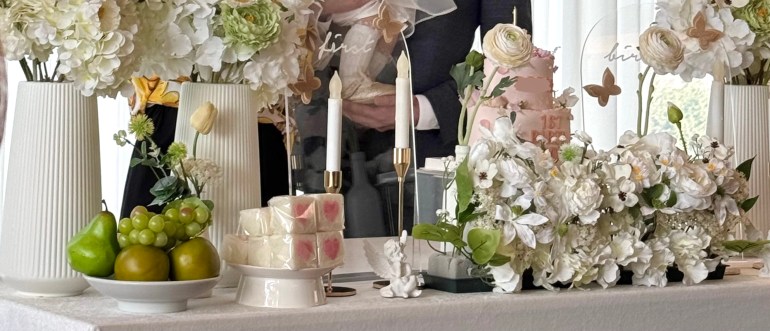
Back again, now in 2025, she has a baby, more of our friends are married, and I’m two years into a Ph.D. Last weekend I got to attend her baby’s first birthday party. In Korean culture, this is an important milestone and celebration called doljanchi. During this celebration, there is also an activity called doljabi where several objects are placed in front of the baby, and whichever one they choose is supposed to represent their future. I had never been to one before so it was really fun to experience.
I went back to Daejeon for the day to attend the party and had the chance to spend time with two other teachers from our office back in 2020. Not only was it great to see them and catch up but it felt good to be there as a peer, as just another guest to this very Korean experience. The ceremony was beautiful and we had a lovely lunch at the hotel where it was held.
Afterward, the other two teachers and I went to grab a coffee nearby and catch up for a while. In my experience, the “after coffee” is always where the most important conversations happen in Korea. For every stuffy team dinner (hweshik in Korean) where you can’t really talk about anything important, there is always a smaller group of people who go out for coffee afterward to complain and vent and laugh and actually share about their lives. I remember when I started being included in these “after coffee” runs when I was here the first time and it still feels just as good to catch someone’s eye when walking out of an event and quietly ask, “Should we go get a coffee?”
So we went for coffee. We all work in different places now and we don’t have the same bosses or students to complain about. But we’re all a little more grown up and the things we worry about are less about the daily workings of school but more existential. How to know if you’re happy at your job. How to find a good partner. Whether or not to have kids. How, if you wait long enough, people really can surprise you.
But in the middle of this conversation, one of the teachers stopped to say “Wait. Devon, your Korean is better than last time. I just noticed how quickly I’m speaking but you’re catching everything, aren’t you?”
I was catching everything. Which is still hard for me to believe. I still go about my life here and sometimes catch myself being shocked by the fact that I can understand what is going on because it was not that long ago that I couldn’t understand anything.
Not only does understanding Korean let me understand the content of our conversations better but I can learn so much more about what kind of people my friends and co-workers are based on how they speak, what kinds of words and grammar they use, and how they talk to other people. We all speak our own versions of our first language. My English is the way it is because of who I am, where I grew up, the people I spend time with, and what I value. And their Korean is what it is because of the same things. It is so cool now to have the ability to see and hear those things when I couldn’t before.
“Before, there were so many things,” she said while gesturing widely “that we wanted to say but could only say this much” moving her hands close together.
“Now we can say all the things we wanted to say.”

I left Daejeon that afternoon and took the bus home with that phrase still in my ears and my heart feeling so full. I’m glad that speaking Korean has given me my career and that it’s helpful academically. But the times when I feel the proudest of my language ability are always in moments like that.
The things we wanted to say were always just about life. About what is hard and what is good about being a human. Ironically, rather than high-brow conversations about complex topics, these are the kinds of interactions that, at least for me, require the most language ability. The ability to make the people you’re talking about hear your words and not just an accent. And to see you for your personality not just your nationality.
As someone who takes a long time to open up to people, I am so grateful for their patience. Not only in investing time to know me, but for trying to speak English when we first met, for being willing to listen patiently all those years as I spoke broken Korean, for waiting until my Korean was good, and for still being open with me, even when we no longer work together.
You can’t make new old friends, as they say. So for me, getting to spend a day with people who know me and who were witnesses to some of the most important years of my life was such a special gift.
Thanks for reading. Don’t let anyone tell you you can’t learn a foreign language as an adult. It only gets better with time.
 Hours and Miles
Love your observations! It is so very true and thoughtful. Even when we are speaking our first/only language, as we travel the country and move from place to place, we listen to the accents and dialects with respect for the person speaking. We know that behind the accents is the person and their experiences. Doing this in two languages is wonderful! Thank you for your words. 💗 Rita
LikeLike